

The part we played in recreating iconic Rolls-Royce Battle of Britain window
On the 86th anniversary of the end of the Battle of Britain, our Managing Director Terry Damms looks at how we replicated a historic tribute to the RAF pilots involved in the campaign for the regenerated Marble Hall development in Derby.
Looking back on our £0.5 million glazing contract at the former Rolls-Royce Marble Hall building, one part of the project stands out above all the rest: the Battle of Britain window.
It was central to the whole scheme, and nothing felt more important than getting it absolutely right. That meant millimetre perfection at every stage – design, procurement, production and installation.
The window was one part of a larger commission – with HKL appointed by Robert Woodhead Heritage Ltd to re-glaze the Marble Hall building, which was being redeveloped for individual office lets.
Working on site from December 2015 to May 2016, the team designed, fabricated and installed Reynaers curtain walling and windows throughout the building – around 50 windows and 10 double doors in all. The Battle of Britain window sat at the heart of it.
A window with a remarkable history
The original Second World War memorial window was unveiled at Rolls-Royce’s Nightingale Road factory in Derby in 1949.
A special train brought guests from London for the occasion, among them Group Captain Douglas Bader – a celebrated Royal Air Force pilot who flew and fought successfully during the war, despite the loss of the lower part of both his legs after a 1931 plane crash.
The factory itself closed in 2007 and the original window later moved to the Rolls-Royce visitor centre in Derby.
On October 31, 2015 – the 75th anniversary of the end of the Battle of Britain – the original was rededicated in a ceremony attended by RAF veterans and Battle of Britain pilots.
Around the same time, a replica was commissioned for the redevelopment of the former Marble Hall factory at Osmaston – and that is where HKL came in.
A window worth getting right
The original stained glass window was a tribute to the RAF pilots who made use of the Rolls-Royce Merlin, considered one of the most successful aircraft engines of the Second World War. The majority of the development work on the Merlin took place at the Derby factory.
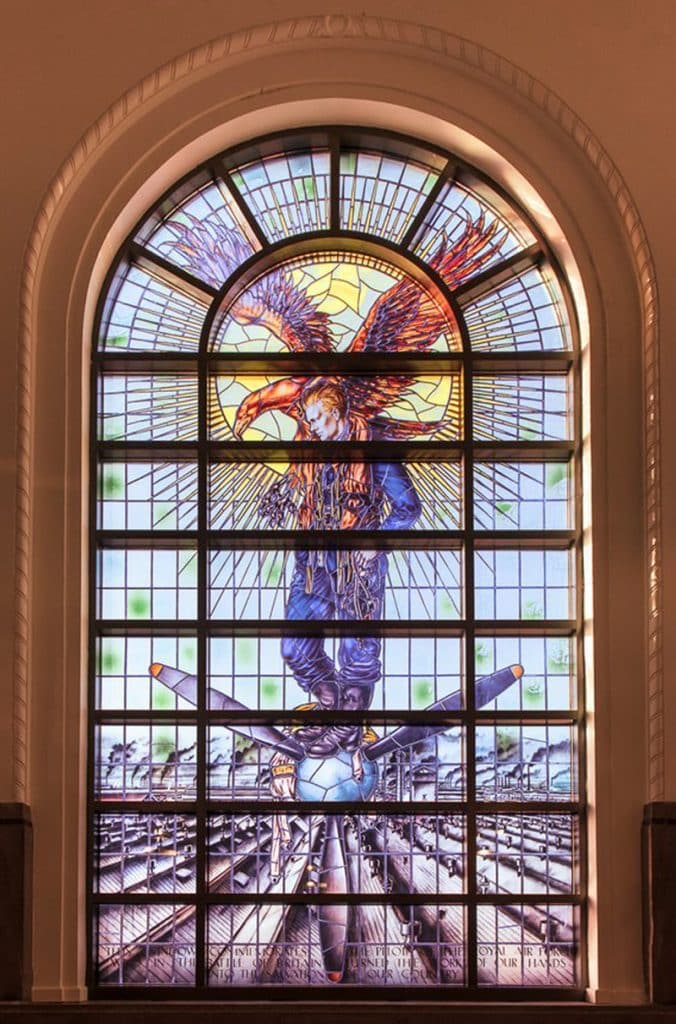
The window itself is striking. Set into a rounded arch and built in multiple colours, it centres on a young RAF fighter pilot – blue overalls, Mae West lifebelt, flying helmet in hand – backed by a golden eagle with wings outstretched.
He stands on the spinner of an airscrew, its three blades filling the lower half of the window, with the buildings of the Derby Rolls-Royce factory stretching out behind them. Three lines of inscription run across the foot in upright capital lettering:
THIS WINDOW COMMEMORATES THE PILOTS OF THE ROYAL AIR FORCE WHO IN THE BATTLE OF BRITAIN TURNED THE WORK OF OUR HANDS INTO THE SALVATION OF OUR COUNTRY.
Our task was to capture the exact spirit of that original – so its story could live on seamlessly within the regenerated Marble Hall.
Starting with the perfect image
Everything began with a photograph – and getting it right was harder than it sounds.
Steve Sexton, our Technical Manager, led the technical execution of the project. He recalls:
“Rolls-Royce gave us special permission to photograph the original, and our photographer spent most of the day on site getting the lighting right.
“Glass reflects everything around it, and the first shots picked up images from within the reception where the original is located.
“It took a second visit to capture an image clean enough to work from. Even then, we went over the print draft time and again, checking every line, tone and detail until we were sure it was a flawless copy.”
Fitting the past into a new frame
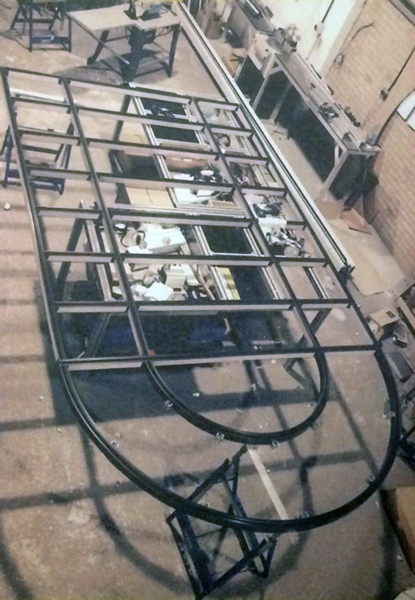
Then came the challenge of the frame itself. Steve recalls: “The original glass was set into a 35mm Crittall frame, while the new overlay sat within a 50mm frame.
“That extra width meant losing parts of the image to make it fit. Yet you would struggle to spot where – the image appears seamless throughout the frame.
“The overlay was so precise, in fact, that it picked up the original’s history too: cracked glass, age-related nicks in the lead and discolouration.”
The making of the replica
Jay Pritchard, our Fabrication Manager, was responsible for bringing the design into physical form.
He said: “It was an honour and a privilege to be given this project to fabricate. We wanted to complete it to the utmost standard – which was certainly a challenge.
“From fabricating the mechanical joints that piece together the curved sections, to measuring and cutting the curves, to measuring out the cleats inside the curves that hold the cross sections together – everything had to be carefully thought through, and every measurement had to be perfect for it all to come together.
“It was a very bespoke design with a lot to think about, but also challenging – and not to mention fun to make. In the end, we were extremely proud and satisfied with how it turned out.”
A window people still come to see
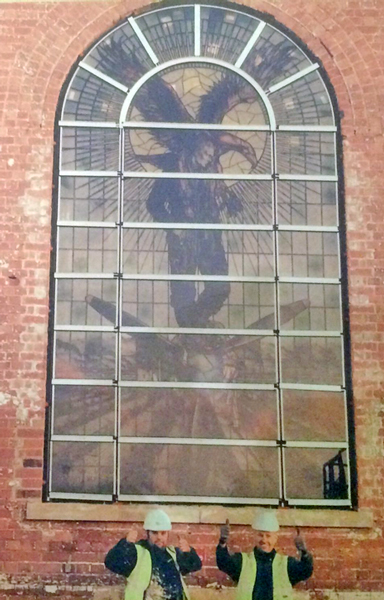
The connection to the project did not end at installation.
As Steve recalls: “My father-in-law did his apprenticeship at the Marble Hall.
“We took him to visit the window and, over coffee in the house café, mentioned the part we had played in replicating it. We were treated like royalty.
“Everyone was fascinated by the process – and we learned the window draws regular visitors throughout the year who come just to see it.”
“In my 45-plus years in this industry, that window gave me more satisfaction than any other.”
HKL’s passion for heritage
For more than 10 years now, the replica has remained a prominent part of the history of the Rolls-Royce Merlin engine, both locally and nationally.
It gives us great delight to think we have contributed, in a small way, to a piece of history marked on October 31 each year. We are rather proud.